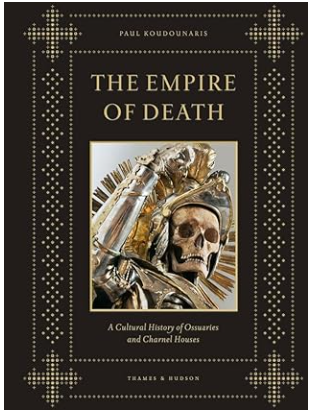
I became fascinated by ossuaries and charnel houses after reading A Tour of Bones by Denise Inge. However, while that book looks at Bone Houses from an emotional lens, The Empire of Death looks at them from a physical and cultural perspective.
The book is full of photographs of what could be the ultimate in funerary art, sculptures and art made with human bones.
However, Koudournaris also tells the stories of the ossuaries and how they came to be. Some of the earliest ossuaries evolved because land for burial space was limited. People were buried and after a set period of time, their bones were dug up to make room for more burials. This left a problem of what to do with the bones that had been dug up. As the early Christians still believed in a connection between the body and the soul, they could not just be disposed of. The solution was to create Charnel Houses where the bones could be displayed and monks to contemplate the transitory nature of human existence.
As time went on, the displays of bones moved from the simple to the more artistic, and now there are displays of skeletons dressed in golden finery, such as the ones at the Basilica of Waldassen in Germany. One of the most ostentatious ossuaries is the Sedlec Ossuary in Czechia, where there is a grand chandelier made of bone and pillars of skulls and long bones.
The one Ossuary on my bucket list is St. Michael’s in Hallstatt, Germany, a small collection of painted skulls. The skulls are grouped into families and are painted with the person’s name as well as decorations such as leaves. These skulls are the ancestors of the town, versus an anonymous pile of bones, and are treated with reverence.
In addition to a wealth of photographs, this book also contains a fairly comprehensive list of ossuaries around the world.